Retreat Day at Newnham on Severn
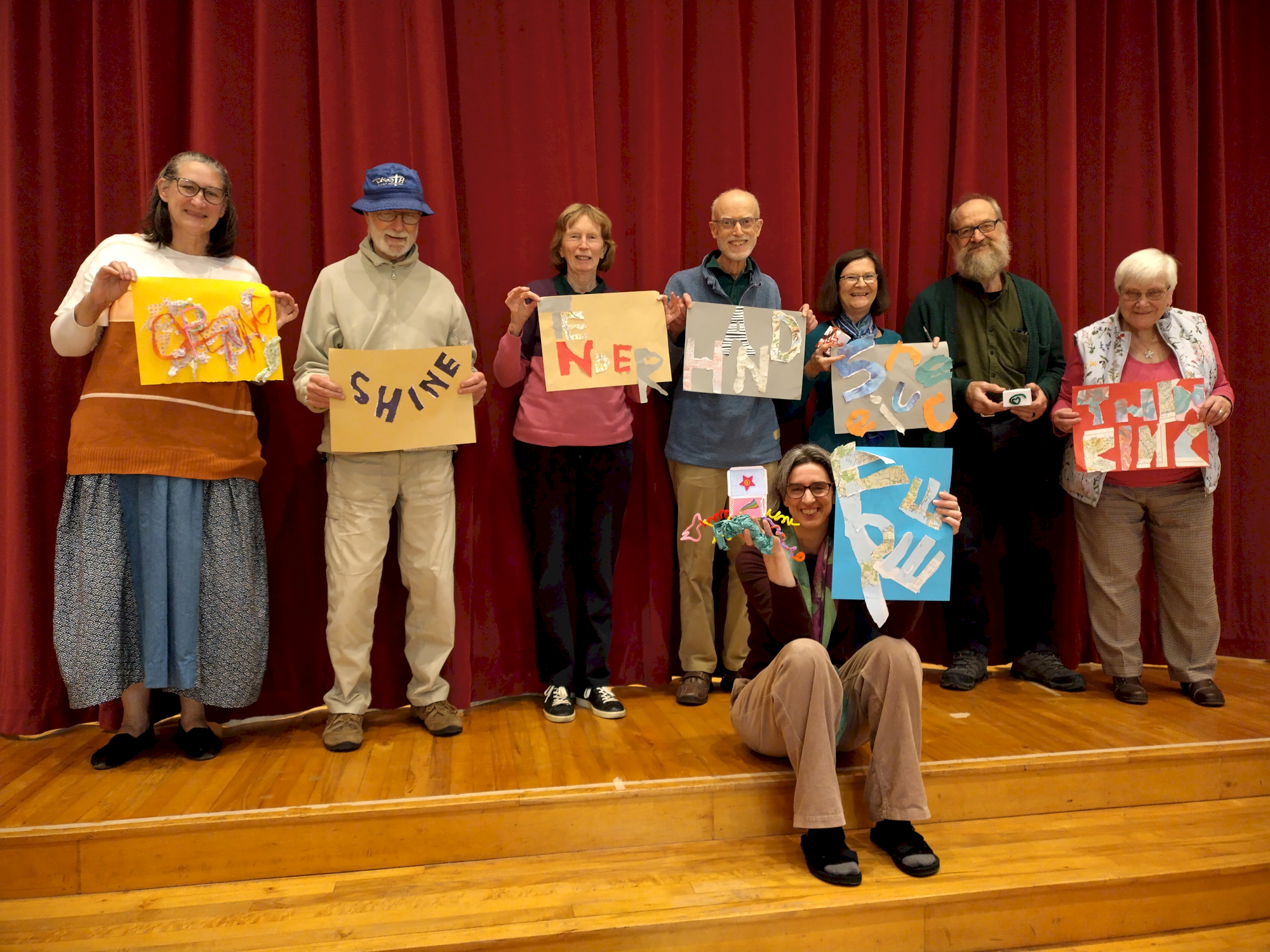
Eight Forest of Dean Friends recently spent a day at the inspiring Tamburlaine Hall attached to the Grange Camphill Village at Newnham. The day was facilitated by Seren Wildwood from Cheltenham Quaker Meeting and centred around the themes of encountering the divine and how that is expressed in our way of life. We all have our own way of envisaging that source of new light and Seren helped us to use our left brain, non intellectual, sensitivities to dig deep into the meaning behind the words we use. The photo is from our last exercise in which we used word association to discover a new and unexpected word that resonated with how we express the divine in our way of life. Seren then showed us a pile of printed paper (old maps and wallpaper) and asked us to make a collage of the letters in that word in just 5 minutes, without using scissors, only our hands. The fact that some are quite neat while others have abandoned neatness probably tells you a lot about our different psyches. From left to right the words are Opening, Shine, Tender, Hand, Serenity (I think), Free and Thinking. Some of us are also holding up the product of a previous exercise, but there's no room to explain that one here! It was a fun day and not at all 'heavy'. Thank you Seren.
Come to try out our silent worship this Sunday, 27th September
As part of the 2026 Quaker Week, we especially invite anyone wishing to try out the Quaker way of silent worship. Reconnect with your inner resource of love and truth as you sit in our shared space. Meeting is followed by chat and refreshments. We welcome anyone who cares to come. Just turn up or if you want to let us know you are coming, email clerks@forestofdeanquakers.org
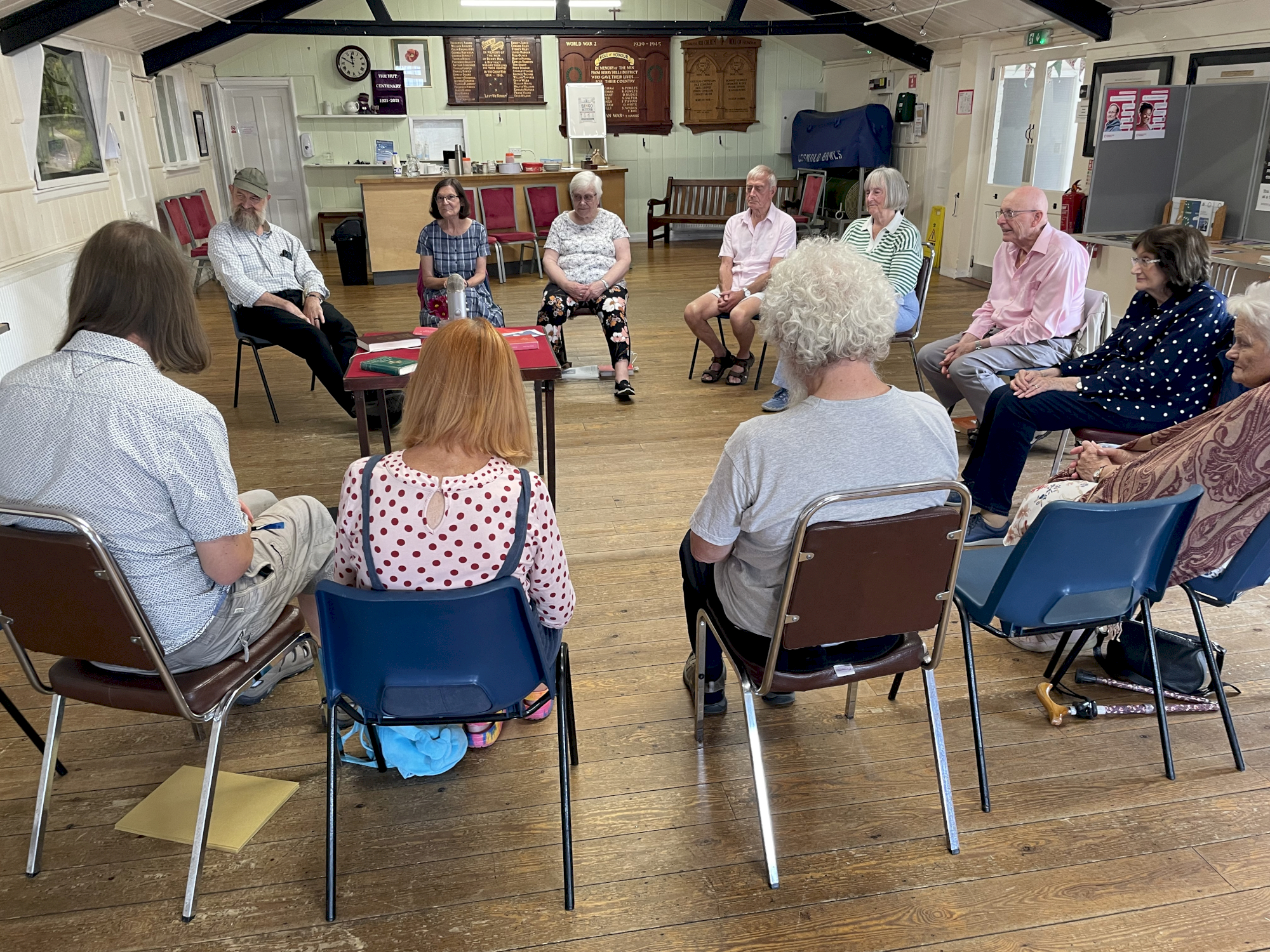
Midweek worship in Quaker Library switched to Tuesday afternoons
Mindful that the evenings are getting darker, we’ve decided to move the midweek Meeting for Worship to a 2.30pm start. We’ve also switched the day to Tuesday too.
Midweek Meetings for Worship are half an hour long followed by conversation.
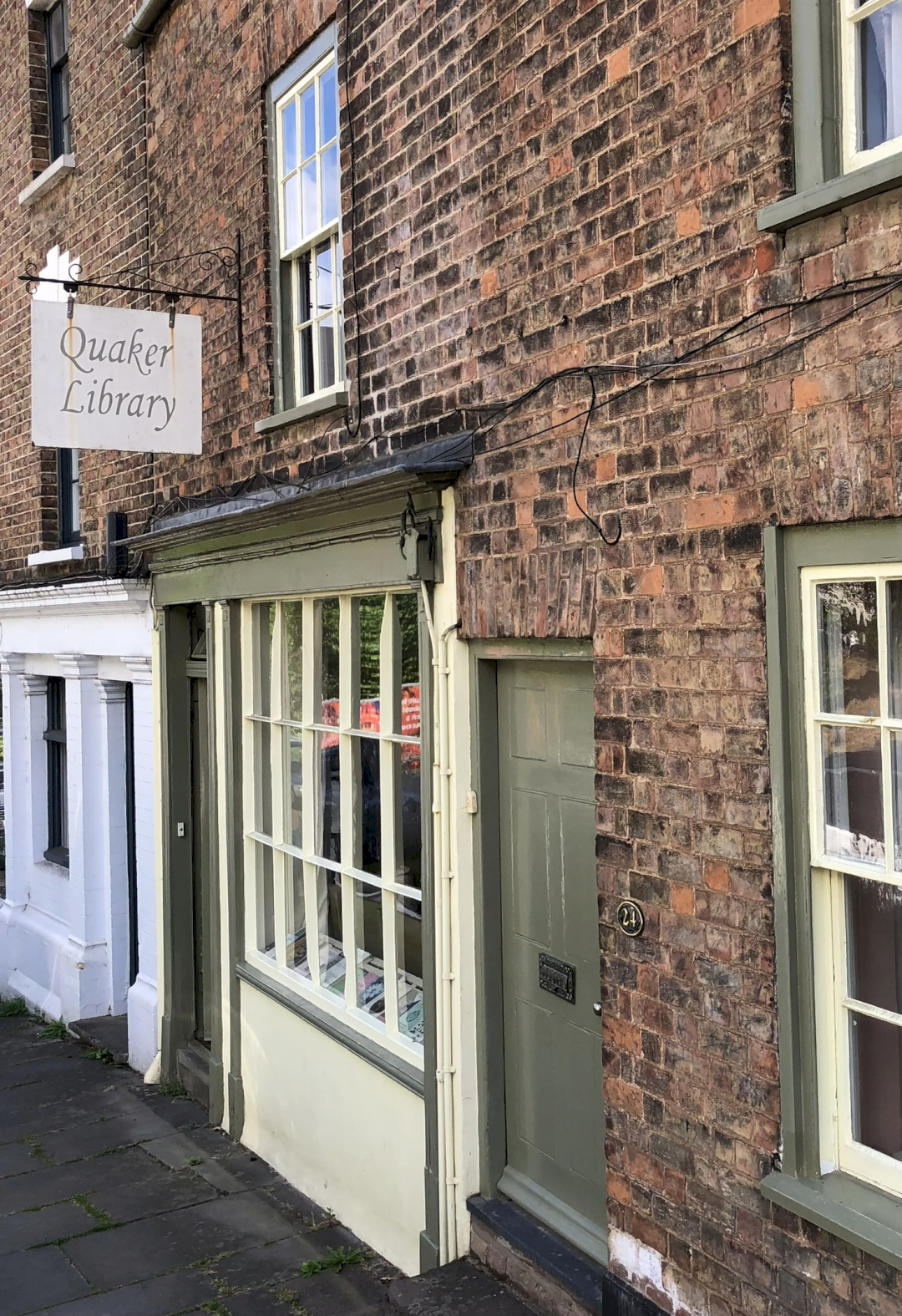
You will find the Quaker Library on the High Street in Newnham. The nearest bus stop is at St Peter’s Church, service No 23.
Our main Sunday Meeting for Worship is held at the Berry Hill Memorial Institute, known as the Hut, at 10.30am
Forest of Dean Peace Campaigners join Quaker Walking Peace vigil in London
There were 12 Foresters on the coach which left Cinderford at 7am in the morning last Saturday, 19th September. By noon we’d joined around 800 others on the embankment ready to walk in silence around Whitehall and Trafalgar Square. The object was to create a ‘loud’ plea for a more peaceful world and to express solidarity with the victims of violent conflicts wherever they have arisen - in our homes, within and between nations. While a Quaker organised event, anyone hoping for a more peaceful future was invited to join in. So we Forest Quakers were delighted when the five of us on this coach were joined by seven other Foresters.
Gathering on the Embankment
Waiting for the coach home
Baptist church filled for Climate Change Film
Around 90 people attended the People's Emergency Briefing film in Coleford last week. The film covers a range of impacts that Climate change is already producing in this country. Many of us know about more heat waves, storms, floods, droughts, wildfires and the film explained some of the adaptations and mitigations that are available and how action taken now, will cost less than the economic disaster if we don't get on with it - about 6 times less. The film also revealed far worse impacts down the line in our children's lifetime - such as reversing the flow of the Gulf Stream, which would plunge the UK into sub-zero winters and boiling hot summers, making it almost impossible to grow food.
The screening was organised by Forest of Dean Quakers and the Coleford Town Council, working together for the first time. The discussion afterwards was facilitated by Peter Bennett, who has devoted his energies to helping get the message of the film to as many venues as possible. Our screening turned out to be the biggest so far in the Forest. About 90 people were in the audience, and most of them stayed for the discussion in small groups which followed. At the end of the evening we collected 45 handwritten postcards to our MP, Matt Bishop. These strongly encouraged him to give his backing to a Parliamentary Call for the government to give the climate crisis the same urgency they gave Covid, and to give us all a televised briefing about what the nation faces and their strategy for our survival.

ALL WELCOME TO VIEW CLIMATE FILM IN COLEFORD
Coleford Baptist Church, Tuesday 7th September at 7pm
Entry free, to secure your place book here https://www.tickettailor.com/events/fodpeoplesemergencybriefings/2346287
FoD Quakers are co-hosting this event and seven of us will be there as volunteers to help the evening go smoothly.
The People's Emergency Briefing is about how we can adapt to climate change. We can't reverse what's already happened but we can adapt to the changes much better than we currently are. If you want Britain to stay fed and healthy and our economy to thrive, come and see this film.
An invitation to our screening of the People's Emergency Briefing
Forest of Dean Quakers and Coleford Town Council invite you to our screening of a new film about the climate crisis. Venue: Coleford Baptist Church on Tuesday September 8th at 7pm.
The film is presented by Chris Packham and features experts in different fields - economics, agriculture, the military, climate science and more. They warn that while our politicians keep kicking climate action into the long grass in favour of "more pressing" issues, like the economy and defence, they are throwing away the best remaining chance we have to save our economy, our health, our food supply, even our military security from the enemy that is already defeating us - which is climate change. This is a call to action for us all to press our politicians to treat climate change as the emergency it most certainly is Reserve your free place: https://www.tickettailor.com/events/fodpeoplesemergencybriefings/2346287
Forest Quakers offer a Midweek Meeting for Worship at Newnham
28/07/2026 We are now holding a midweek Meeting for Worship at 7pm every Wednesday in the Quaker Library. This provides Friends and visitors with an alternative time and venue to our regular Sunday worship in Berry Hill. The cushioned benches of the Quaker Library in Newnham are ideal for a small gathering. For further information please contact Amelia Schafer-Rutherford at ameliaschafer@gmail.com
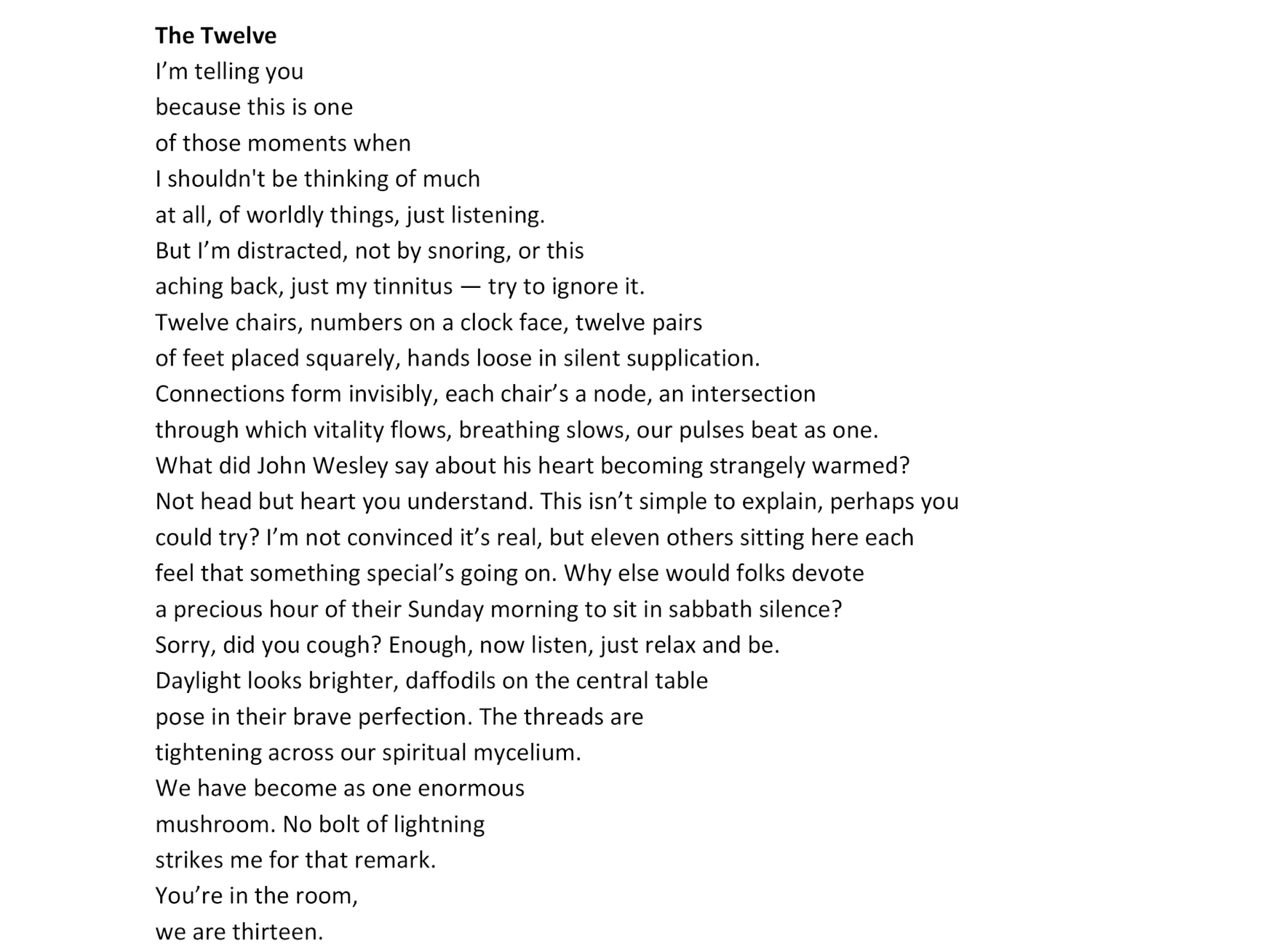
The Twelve, a poem about Quaker Worship by Pam Horne
11/07/2026 People often wonder what happens when Quakers meet in silent worship. If asked we would describe it many different ways. Pam Horne has expressed her answer through poetry, which often makes the best religious language. She tells me that the shape of the poem represents a breath - drawing in - letting go.
Quakers back national film campaign to spark climate action and justice
Quakers in Britain are supporting a national film campaign intended to help everyone better understand the scale and urgency of the climate and nature crisis. The People’s Emergency Briefing is being shown in towns and villages throughout the nation. It explains how the climate crisis is already changing our way of life - the economy, our health, food supply, even our national security. But it is also a message of hope. If we name it as the emergency it is, like we did with the Covid pandemic, there are mitigations available now which would reduce the damage and even bring financial benefits for the economy. The main message of the film is to get our MPs to stop kicking this into the long grass and to press the government to bring this to the top of their agenda.
The People’s Emergency Briefing is being shown at The Club in Newnham on Thursday 16th July. To reserve a place, please use this link: https://www.trybooking.com/uk/events/landing/116747 . There will be other showings around the Forest and we aim to bring you news of these as they are announced. Check our Events page. Each showing is followed by a discussion about the action we could be taking.
Tanya Jones, who is the climate justice lead for Quakers in Britain said “Everyone is affected by climate change, but not equally. In calling for urgent action, we must ensure the pressure falls where it belongs, on major polluters, decision-makers and the ultra-rich, not on ordinary people already struggling to get by. Our hope is that this film helps people see both the urgency and the possibility, and inspires action rooted in justice."

Silent Walking Vigil for Peace
Quakers across Britain are planning a Walking Vigil in Central London on September 19th 2026. The aim is to show solidarity and care for everyone impacted by violence, conflict and war - a “loud silence” witnessing for peace to which all peace loving people are welcome.
The vigil will begin with a short meeting for worship in the Quaker way. We will be walking quietly at a slow pace. A walking vigil is an inherently peaceful activity: not a protest, not a march, not a demonstration. We will pause along the route for further worship. The walking vigil will conclude with a final meeting for worship, at the end of the route. If you hope to attend, please let the organisers know here.
We are hoping to organise a coach from the Forest of Dean so it you are interested in having a place on it, please email our clerk, Andy Vivian at clerks@forestofdeanquakers.org
Forest Quakers are aiming to reduce our carbon footprint. How are we doing?
In 2021, British Quakers made the 'Canterbury Commitment' to become a low carbon sustainable community. Here in the Forest of Dean we don’t own our building but as a community we are trying to make a difference in our personal lives. In 2023 we carried out our first survey on how we are doing – there were 8 responses. This year we did another – there were 11 responses. Our methodology was not consistent but some conclusions were apparent.
- Recycling, loft insulation and double glazing are the measures most widely adopted by our members.
- Most of us remain committed to gas for heating, though one household has recently installed a heat pump
- Nearly all of us have chosen green suppliers of electricity and the number of installed solar PV and storage batteries has gone up from 1 to 3 since 2023.
- Over half of us try to be sustainable when sourcing our food – we check out air miles and prioritise local produce. A similar number grow at least some of their own food. One area we need to consider next time is our consumption of meat.
- We make good use of charity shops for both donations and purchases.
- Travel remains our greatest challenge – we are highly reliant on single-occupancy car travel. Only two of the eleven respondents in 2026 drive an electric car, which is down from 2023!
Some questions arising from these results
- Could we increase the number of Quakers sharing the journey to Meeting on Sunday? (We meet at The Memorial Hall in Berry Hill)
- As cars need to be replaced, could/should more of us opt for EVs?
- Can we source good advice about retrofit options such as solar PV, battery storage, heat pumps and wall insulation?
- Can we actively promote sustainable food options such as the Forest Food Hub and community gardens.
- What is the role that meat plays in our diets and their sustainability
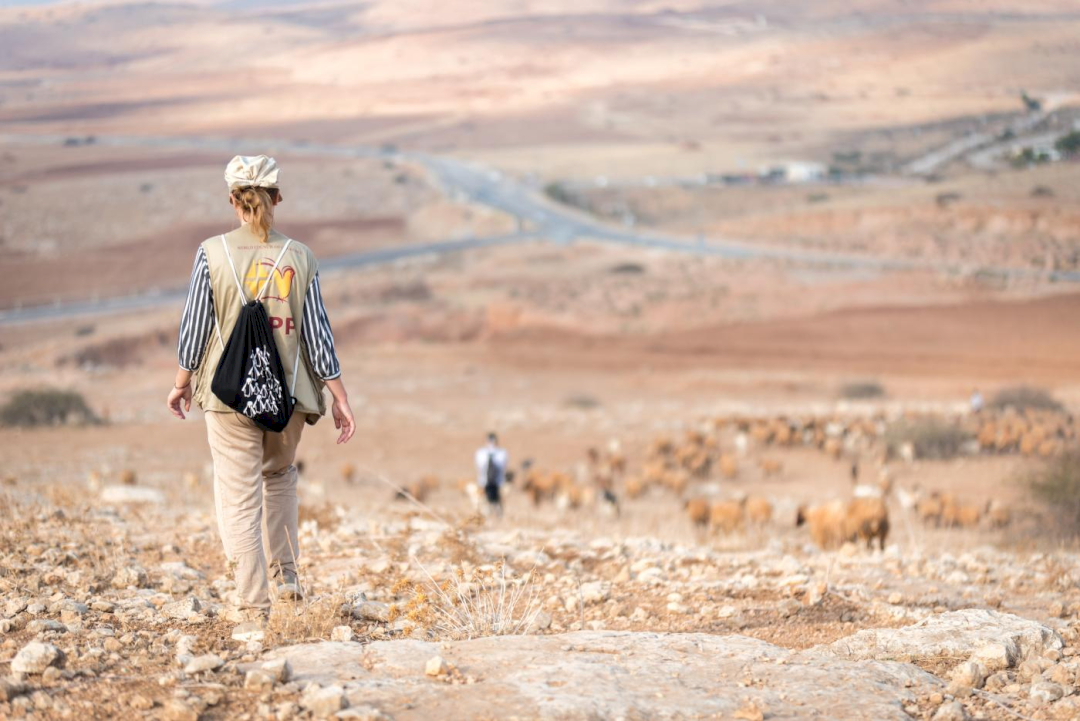
Ecumenical Accompaniers withdrawn from the West Bank
The hostilities have led to the World Council of Churches (WCC) to withdraw eleven volunteers from the West Bank for their own safety. They were part of the Ecumenical Accompaniment Programme, Palestine and Israel (EAPPI)*. The evacuations took place in March, soon after the start of the latest war between Israel/US and Iran. The programme Coordinator, Iskandar Majlaton, expressed his concern about the vacuum left behind. "Palestinian communities, already facing intensifying settler violence, land annexation, and systematic dispossession, are now left without the vital presence of international protective accompaniment.” Volunteers continue to stay in touch with local families using the internet but a WCC spokesperson, Carla Khijoyan, calls on the international community take action. "The cry of those who suffer must awaken the conscience of the international community to act with courage—for the protection of civilians, for justice, and for a peace that honours the dignity of every human being.”
*EAPPI volunteer recruitment and training in the UK is carried out by Quakers in Britain.
Why do Quakers talk about Climate Injustice?
From Quaker Advices and Queries No 28: "Attend to what love requires of you." And when it comes to love in action, Quakers are guided by their five testimonies to Truth, Equality, Peace, Sustainability and Simplicity.
When it comes to climate change there are some significant inequalities. Evidence of this was highlighted in a report from the International Institute for Environment and Development.
Commenting on its conclusion, Prof. Paul Behrens of Oxford University, who works on food security, noted, "The effects of climate change, including drought, floods, fires and disease, will damage food production in every region of the world. But it is people already harmed by inequality, exploitation and conflict, people who are least responsible for greenhouse gas emissions, who will suffer the most. Today eight countries in the world are critically food insecure. In a world that is two degrees hotter, that number rises to 24. Food insecurity for high-income countries will worsen by 3%; for low-income countries by 22%.
Learn more about Quakers and climate justice
Faith leaders plea regarding new protest legislation rejected in the Commons
This week MPs voted to give police the power to ban a protest if it is planned for the same location as earlier protests. The government says it wants to protect an organisation from repeated protests through what is being called the 'cumulative action' restriction. But Christian, Jewish, Muslim, Hindu, Sikh, and Buddhist leaders pointed out that peaceful protest has often involved cumulative action. Campaigns that changed the world from the suffragettes to communities standing up against fracking were built on repeated, sustained demonstration.
The UN Special Rapporteur on the Right to Freedom of Peaceful Assembly recently told UK civil society organisations and MPs that she was seriously concerned about these repressive new laws and the clause on cumulative disruption in particular. The Crime and Policing Bill is the third piece of anti-protest legislation in recent years.
Responding to the vote, Paul Parker, Recording Clerk of Quakers in Britain said:
“Peaceful protest motivated by faith, belief and love should be celebrated, not criminalised. This legislation adds to the increasingly hostile climate for protesters who seek a better world for us all. Quakers will continue to campaign for these measures to be repealed and for a healthy democracy in which ordinary people can hold their leaders to account. That is what it takes to build a truly peaceful world."
Paul is due to give evidence to the parliamentary Joint Committee on Human Rights on Wednesday 15 April on how protest restrictions are affecting Quakers.
A clause to create a new category of 'Extreme Criminal Protest Group' was removed from the bill.
Our new good cause for the second quarter
Forest of Dean Quakers have chosen to collect for the International Committee of the Red Cross for the coming three months, April - June. This reflects our Meeting's concern for the victims of the several conflicts in the Middle East. The ICRC works closely with their Islamic counterparts, the Red Crescent Society. The fighting has created a huge number of displaced and homeless people and these two organisations have a great deal of experience in helping with temporary shelter, food and resettlement.
UK should work for peace not war in the Middle East, Quakers say
Quakers in Britain have called on the UK government to focus on building a just and sustainable peace in the Middle East. The call comes after the news that British military bases will be used to bomb Iran as part of 'defensive' operations to attack missile facilities.
Quakers warn that military action will not make Britain or its allies safer. It will escalate the conflict, deepen regional instability, and endanger countless more lives. "As Quakers, we believe that every life is precious," said Paul Parker, Recording Clerk of Quakers in Britain. "We mourn every life already lost because of this conflict and fear the lasting implications if it is allowed to spread".
"Stability and security are achieved through dialogue, diplomacy and careful long-term peacemaking, not through threats or weapons, which bring destruction, pain and death."
Parker's words follow a statement by the American Quaker organisation, Friends National Committee on Legislation, which strongly condemns US and Israeli actions as well as the violent actions of the Iranian government towards its own people.
Hilary Topp visit planned for Sunday March 8th
We look forward to welcoming our Quaker Local Development Worker for Gloucestershire and the West Midlands, Hilary Topp, to our Sunday worship. She will be answering questions afterwards. One of her roles is to help Meetings to think about their outreach. This is a pertinent subject for us this year as we seek discernment about the nature of our outreach and whether to hold an event in the autumn. So on Sunday we'll have a chance to chat with Hilary about what outreach is, what is making younger people interested in Quakers and what can sometimes put enquirers off.
Our good cause for the first quarter of 2026
Forest of Dean Quakers have adopted Stop Ecocide International as something we will individually support with our giving. Each quarter we choose a different good cause or charity. We invite readers of this website to learn more about this campaign to bring to justice those nations and industrialists who perpetrate large scale destruction of eco-systems . Stop Ecocide International - Developing Ecocide Law
Good turn out to celebrate the contribution of our retiring clerk
On Saturday 31st January, almost our entire community of Forest of Dean Quakers met together for a bring and share tea to say thank you to our retiring clerk, Dorothy Cardus, who for six years has kept us in order at our business meetings, dealt with our correspondence, kept our records straight and much more besides. We are grateful for her diligence, her wisdom and her kindness.
Quakers oppose plans to make it harder for migrants and refugees to get permanent settled status in the UK
The Government’s consultation on its new rules ends on February 14th 2026. Quakers are being encouraged to make their views known.
In a statement, Quakers say the Home Secretary’s changes are inhumane and divisive. If they becomes law, then refugees who currently have to wait five years before they can apply for the permanent right to remain can expect to wait 20 years. If refugees are deemed to have arrived illegally, the expected wait would be 30 years. A refugee’s status would be reviewed every 2.5 years, with return enforced if conditions are judged "safe”.
Quakers across Britain, many working alongside refugees and people seeking asylum, argue these new measure are divisive and unworkable.
"They will discourage employers and landlords, deepen poverty and unemployment and obstruct integration, harming us all."
The Quaker Asylum and Refugee Network believes government policy is being driven by unfounded narratives.
“Refugees and migrants are essential to our wellbeing, our public services and our economy. We call for genuinely fresh policies that allow people to recover and make their contribution”
Read the complete the Home Office consultation document. The consultation closes on Thursday 12th February.
How much should I give to support Quaker work?
In our Forest Quaker Meeting we collectively decide how much of our income to send to the Gloucestershire Area Meeting, which is our 'parent' Meeting and whose Trustees are responsible for us to the Charity Commission. In practice we receive a suggested sum from the Area Treasurer each year and we try to meet that, sometimes we fall short, and sometimes we exceed it.
But there is also another call on our giving which is the work of our national body, Quakers in Britain, home to a large number of good works, both outward facing, such as maintaining a Quaker voice on the national stage and within Quakerism, such as the training and support they provide regionally and locally. In their new guide to giving, Quakers in Britain ask us to consider giving more to our national headquarters. They refer to a formula which some Friends use. This states that if you can afford £42 a month, you might give a 6th to your local Meeting, a 3rd to the Area Meeting, and half to our national body for use by Quakers in Britain. The guide is called How much should I give to support Quaker work?
How to support Palestine while avoiding antisemitism
Quakers expressing support for Palestine is nothing new. But it is important that our support is voiced in ways that avoid being antisemitic. We haven’t always got this right. A new guide has been published by Friends' House in London called Challenging Antisemitism. The aim of the guide is to prevent antisemitism among Quakers, deliberate or unintentional and to help Quakers challenge antisemitism when we come across it . Copies of the guide have been sent to each local Quaker meeting, and is available to order or download online (PDF). Quakers are encouraged to read the guide, to discuss it, and to reach out in friendship to local Jewish communities.
Dates of our business meetings (Meetings for Worship for Business) in 2026
Forest of Dean MfWfB follows our 10.30 hour of Meeting for Worship. It usually starts about 11.45 and can be attended via Zoom.
Sunday 1st February
Sunday 22nd March (Please note this change. Date was originally 5th April)
Sunday 7th June
Sunday 5th July
Sunday 6th September
Sunday 4th October
Sunday 1st November.
Mince pie party December 2025
Friends gathered around the open fire at the Quaker Library in Newnham at the end of December to enjoy a mince pie and great conversation.
Meeting with Local MP, end of October 2025
Friends met with the Forest of Dean MP, Matt Bishop at the end of October. Matt brought his researcher and work experience person with him. We enjoyed an hour of questions and answers, followed by tea and cake.
Scone party, September 2025
Around 15 friends gathered at Anne's house for a scone party at the end of September. It was a lovely time to chat informally and get to know each other, over a huge spread of cakes, scones and savouries.
Shared supper, August 2025
Friends gathered at the Quaker library for a shared meal with Seren and Alex.
Summer picnic, June 2025
Friends enjoyed a summer picnic at Keith's house, with shared food and paddling in the river.
Quaker Library - activism group, January - March 2025
In early 2025, a group of Friends from the Forest of Dean Quaker Meeting, met at the Quaker library in Newnham to discern topics of concern. The Meeting sent a letter to the local MP, Matt Bishop, to express our concerns and requesting a meeting. We also contacted Forestry England concerning their tree felling policy in relation to climate change.